

Disclaimer:
I’m sharing what’s worked for me and my family in hopes it blesses yours too — but I’m not a doctor, and this blog isn’t meant to give medical advice. Every body is different, so please check with your pediatrician, doctor, or trusted health professional before making any significant changes to your family’s diet, supplements, or health routine.
My Allergy Story: How I Naturally Healed My Allergies
Although I didn’t have them as a kid, I developed allergies as an adult. They weren’t usually bad, but sometimes they would flare up to the point where I was tied to a tissue box and looked like I’d been through an awful breakup.
Over time, they seemed to worsen. Every evening as I went to bed, something in my bedroom made me congested during the night. I cleaned everything thoroughly, but it was still a problem. Eventually, I figured it was something in my air ducts, so I covered the duct nearest my bed — and that seemed to help — but it wasn’t a long-term solution.
Yes, I probably need to get my ducts cleaned, but I would still have random allergy attacks while doing yard work, especially where lots of decomposing material was involved. I figured I had some sort of mold allergy.
I live in Tennessee, which is a lovely state, but there are all sorts of environmental allergens because everything grows here! Simply moving to a drier state wasn’t an option, nor did I want to move — but allergies were taking a toll on my day-to-day life. I didn’t want to take medication every day because I hate taking pills in general. I also didn’t want to go through expensive medical treatments. Doctors often used a bandage approach rather than fixing the root of the problem.
When I Turned to Holistic Health
Around this time, I became interested in holistic medicine and natural healing. It had worked well for treating my daughter’s eczema, and I was interested in learning more. I read a book called The Plant Medicine Protocol, which explored different plants and their various medicinal uses. For environmental allergies, it suggested strengthening the immune system in general as the best healing method.
I learned that 70–80% of the immune system is tied to the gut, so by strengthening your gut microbiota, you could in turn strengthen your immune system.
My First Step: Kefir
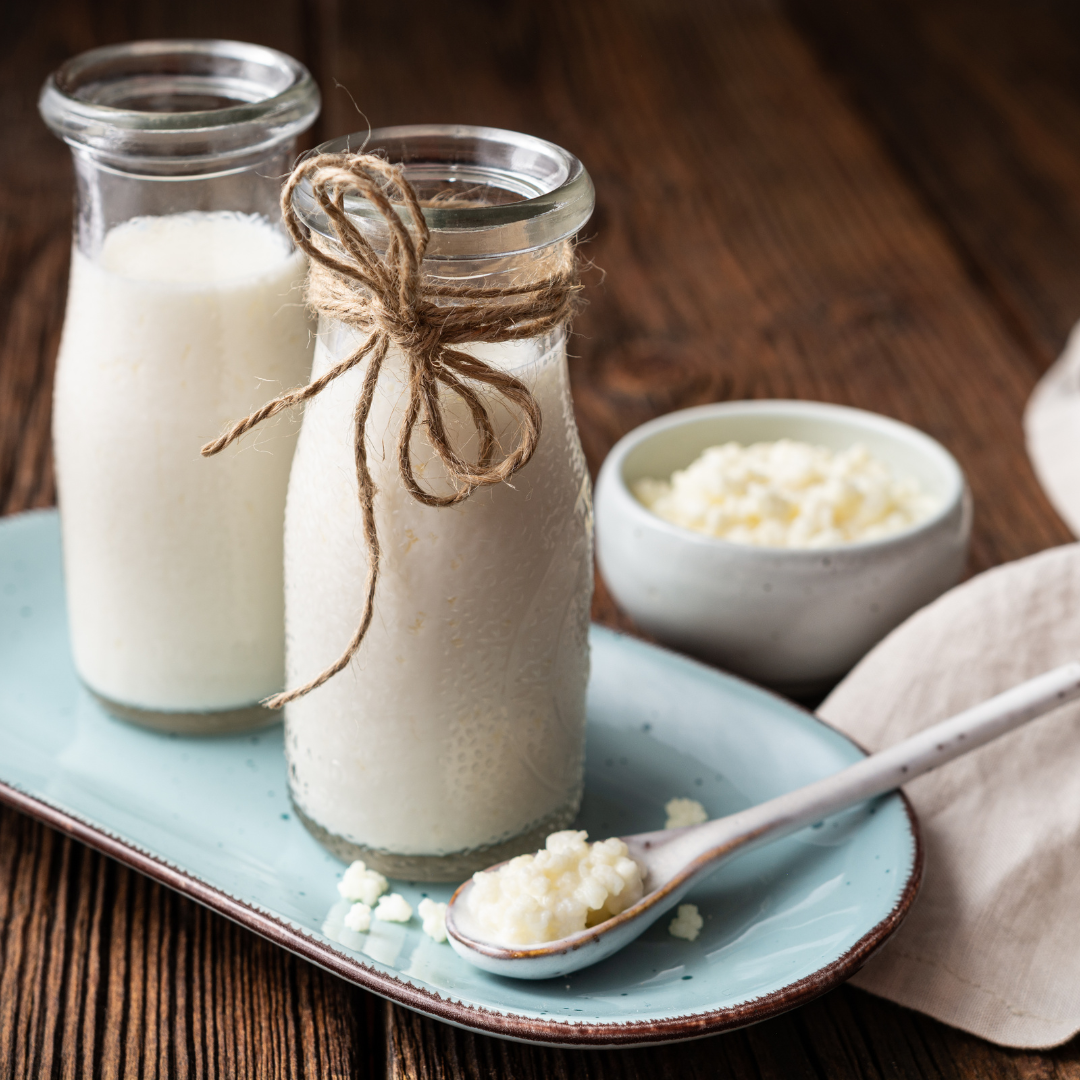
One of the first methods I tried for strengthening my immune system was kefir. Kefir is a form of fermented milk. It has a very sour taste and isn’t very appetizing, but it’s supposed to have a wide variety of beneficial bacteria. I started mixing up a kefir smoothie for myself every day — and I started to notice my allergies improving!
Although I can’t credit this entirely to kefir — I was also making other changes to our family’s diet, like reducing sugar and processed foods — I did come across some interesting research about why kefir is one of the best foods for allergies.
What Happened When I Stopped Drinking Kefir
After my immune system and allergies improved, I got out of the habit of drinking kefir every day. After a while, I started to notice my allergies flaring back up — even though our diet and lifestyle hadn’t changed. I drank more kefir, and the allergy symptoms subsided!
This was fascinating to me, so I began to research why kefir was so effective. Here’s what I learned:
Why Kefir is So Effective:
Short version:
- A diverse and balanced gut helps regulate allergic responses
- Specific bacteria strains reduce seasonal allergy symptoms
- Kefir has some of the best strains for reducing those symptoms compared to other forms of probiotics
Long version:
1. 70–80% of the immune system is in the gut
• The gut-associated lymphoid tissue (GALT) helps train your immune system to tolerate harmless substances (like pollen or pet dander).
• If the gut is imbalanced (due to poor diet, antibiotics, or inflammation), this immune training can break down — leading to overactive immune responses, or allergies.
2. Gut microbiota helps regulate immune tolerance
• A diverse and balanced gut microbiome promotes the development of regulatory T cells, which suppress inappropriate allergic responses.
• Dysbiosis (imbalanced microbes) has been linked to higher rates of asthma, allergic rhinitis, and eczema.
3. Leaky gut may worsen immune reactivity
• If the intestinal barrier is compromised (a.k.a. “leaky gut”), toxins and microbes can enter the bloodstream and activate the immune system.
• This chronic low-grade inflammation can make the body more sensitive to allergens in the environment.
Probiotic Strains That May Help with Allergies
| Probiotic Strain | Proven or Suggested Benefits | Natural Food Sources |
| Lactobacillus rhamnosus GG | Reduces seasonal allergy symptoms, improves gut barrier function | Fermented dairy (kefir, yogurt) |
| Lactobacillus paracasei | May reduce nasal congestion, allergic rhinitis, and inflammation | Fermented vegetables (kimchi, sauerkraut) |
| Lactobacillus plantarum | Anti-inflammatory effects, may help with skin and respiratory allergies | Fermented vegetables (sauerkraut, pickles), sourdough |
| Bifidobacterium lactis | Enhances immune response, may reduce hay fever symptoms | Yogurt, kefir, fermented milk products |
| Bifidobacterium longum | Modulates immune response, supports gut lining health | Yogurt, some cultured dairy |
| Lactobacillus casei | May help reduce inflammatory markers and improve allergy tolerance | Yogurt, kefir, miso, fermented dairy |
| Lactobacillus reuteri | Regulates immune balance, supports mucosal barriers | Yogurt, kefir, breastmilk (naturally in infants) |
Why Kefir Stood Out
Kefir is top on the list for the number of different probiotic strains it carries. It’s the best choice for allergy relief. Although it isn’t the most appetizing, it’s had an amazing effect on my health. It not only helped with allergies but completely transformed my immune system!
If you’re interested in using kefir to help alleviate your seasonal allergies and strengthen your immune system, check out my post on how to use kefir. I’ll include some of my favorite recipes to make it more palatable. It’s certainly an acquired taste, but over time even my kids have grown to like it — and we are so much healthier for it.
Final Thoughts
As always, I hope this information is helpful to those struggling with allergies. Although this may not cure allergies altogether, I hope it helps bring some relief.
Best of luck!
— Katie
Research
P.S. Here are the sources I found for my research. I always like to include these in case you would like to learn more!
Alvarez, M., & de Moreno de LeBlanc, A. (2025). Probiotic supplementation improves SCORAD and quality of life in children with food allergies: A randomized clinical trial. Frontiers in Nutrition, 8, 1565436. https://doi.org/10.3389/fnut.2025.1565436
Bariah, A., Alharbi, R., Alayadi, A., Alamri, M., & Al-Asmari, A. (2025). Efficacy of Lactobacillus and Bifidobacterium in allergic rhinitis: A narrative review. Cureus, 17(7), e53869. https://www.cureus.com/articles/386694-efficacy-of-lactobacillus-and-bifidobacterium-in-allergic-rhinitis-a-narrative-review.pdf
Białas, K., & Słotwiński, R. (2021). Probiotics in the modulation of immune responses in respiratory allergies. Frontiers in Microbiology, 12, 688137. https://doi.org/10.3389/fmicb.2021.688137
Canani, R. B., Sangwan, N., Stefka, A. T., Nocerino, R., Paparo, L., Aitoro, R., & Meddings, J. (2017). Lactobacillus rhamnosus GG-supplemented formula expands butyrate-producing bacterial strains in food-allergic infants. Journal of Allergy and Clinical Immunology, 139(6), 1983–1986. https://doi.org/10.1016/j.jaci.2016.12.1001
Ciprandi, G., Silvestri, M., & Tosca, M. A. (2004). Probiotic administration modulates allergic inflammation in children with rhinitis. Allergy & Asthma Proceedings, 25(6), 455–459. https://doi.org/10.2500/108854104778062106
D’Auria, E., & Vitellio, P. (2020). Probiotics and their function in the modulation of the immune system in allergic rhinitis. Allergologia et Immunopathologia, 48(6), 756–763. https://doi.org/10.1016/j.aller.2020.02.005
Fang, H., Elina, T., Heikki, A., & Seppo, S. (2000). Modulation of immune response in patients with seasonal allergic rhinitis by probiotic bacteria: A pilot study. Clinical & Experimental Allergy, 30(11), 1595–1600. https://doi.org/10.1046/j.1365-2222.2000.00976.x
Hacini-Rachinel, F., Gheit, H., Le Luduec, J. B., Dif, F., Nancey, S., & Kaiserlian, D. (2009). Oral probiotic control of skin inflammation by acting on both effector and regulatory T cells. PLoS ONE, 4(3), e4903. https://doi.org/10.1371/journal.pone.0004903
Hong, H. M., & Jeong, M. (2023). The role of probiotics in the modulation of mucosal immunity and prevention of food allergy. Current Research in Food Science, 5, 321–328. https://doi.org/10.1016/j.crfs.2022.09.004
Huang, R., Zhou, L., Wang, Y., & Li, X. (2022). Probiotics supplementation for prevention of asthma: A systematic review and meta-analysis. Frontiers in Nutrition, 9, 821900. https://doi.org/10.3389/fnut.2022.821900
Lee, Y. J., Kim, J. Y., & Ko, G. (2022). Lactobacillus plantarum Z01 modulates allergic airway inflammation through microRNA regulation in a mouse model. Allergy, Asthma & Clinical Immunology, 18(1), 34. https://doi.org/10.1186/s13223-022-00753-4
Park, S., Ji, Y., Jung, H. Y., Kim, H., & Hyun, C. K. (2021). Immunomodulatory effects of Lactobacillus plantarum: A review of in vitro and in vivo studies. Microorganisms, 9(3), 739. https://doi.org/10.3390/microorganisms9030739
Shin, H. S., Lee, J. S., Seo, J. G., & Jeong, Y. (2024). A randomized, double-blind, placebo-controlled trial of probiotic NVP-1703 in children with perennial allergic rhinitis. Journal of Korean Medical Science, 39(15), e266. https://doi.org/10.3346/jkms.2024.39.e266
Špacová, I., Petrovská, M., & Budišová, M. (2020). Recombinant probiotic Lactobacillus rhamnosus GR-1 expressing a birch pollen allergen suppresses allergic asthma in mice. Probiotics and Antimicrobial Proteins, 12, 1459–1472. https://doi.org/10.1007/s12602-020-09658-7
Wassenaar, T. M., & Zimmermann, K. (2018). Lipopolysaccharides in food, food supplements, and probiotics: Should we be worried? European Journal of Microbiology and Immunology, 8(3), 63–69. https://doi.org/10.1556/1886.2018.00012
Yang, B., Lu, Y., & Luo, Y. (2016). Probiotics and food allergy. World Journal of Clinical Pediatrics, 5(4), 237–244. https://doi.org/10.5409/wjcp.v5.i4.237